A constitutional profile drawn from three traditions — Chinese, western and Indian — built into the patient record.
CrystalSolutions and PraxisClinic include a Five Elements and astrology module that generates a multi-layered constitutional profile for each patient from their date of birth. It sits alongside the clinical record as a tool for reflection — not a diagnostic system, but a framework that many holistic practitioners find genuinely useful when considered alongside direct observation and case history.
What is the Five Elements system?
The Five Elements (Wu Xing) is a foundational framework in Traditional Chinese Medicine. The five elements — Wood, Fire, Earth, Metal and Water — describe patterns of energy, movement and relationship that can be observed in nature, in the body, and in the character of a person. Each element is associated with specific organ systems, meridians, emotional tendencies, seasonal energies and constitutional strengths and vulnerabilities.
In clinical practice, identifying a patient’s primary element provides a constitutional context for their presenting condition — helping the practitioner understand not just what is happening, but why this pattern might be occurring in this particular person.
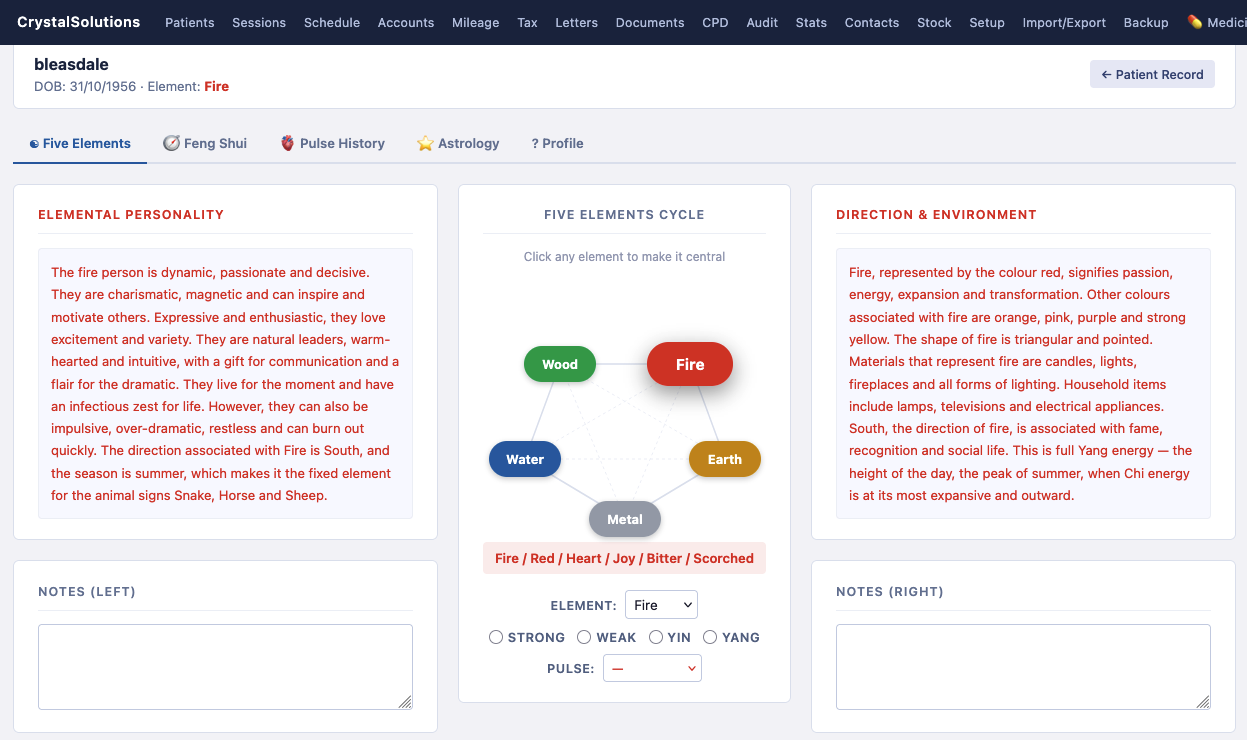
The interactive Five Elements pentagon
At the centre of the module is an interactive pentagon diagram showing the Five Elements cycle — both the generating (Sheng) cycle and the controlling (Ke) cycle. The patient’s derived element is highlighted at the centre, with the associated organ pairs, emotional correspondences and likely acupuncture syndrome patterns shown alongside.
Practitioners can override the DOB-derived element if clinical observation suggests a different primary element, and the pentagon updates accordingly. The element can be saved to the patient record and reviewed over time.
How the profile is built
The module draws on three astrological traditions, each offering a different lens on the same person:
Chinese Astrology
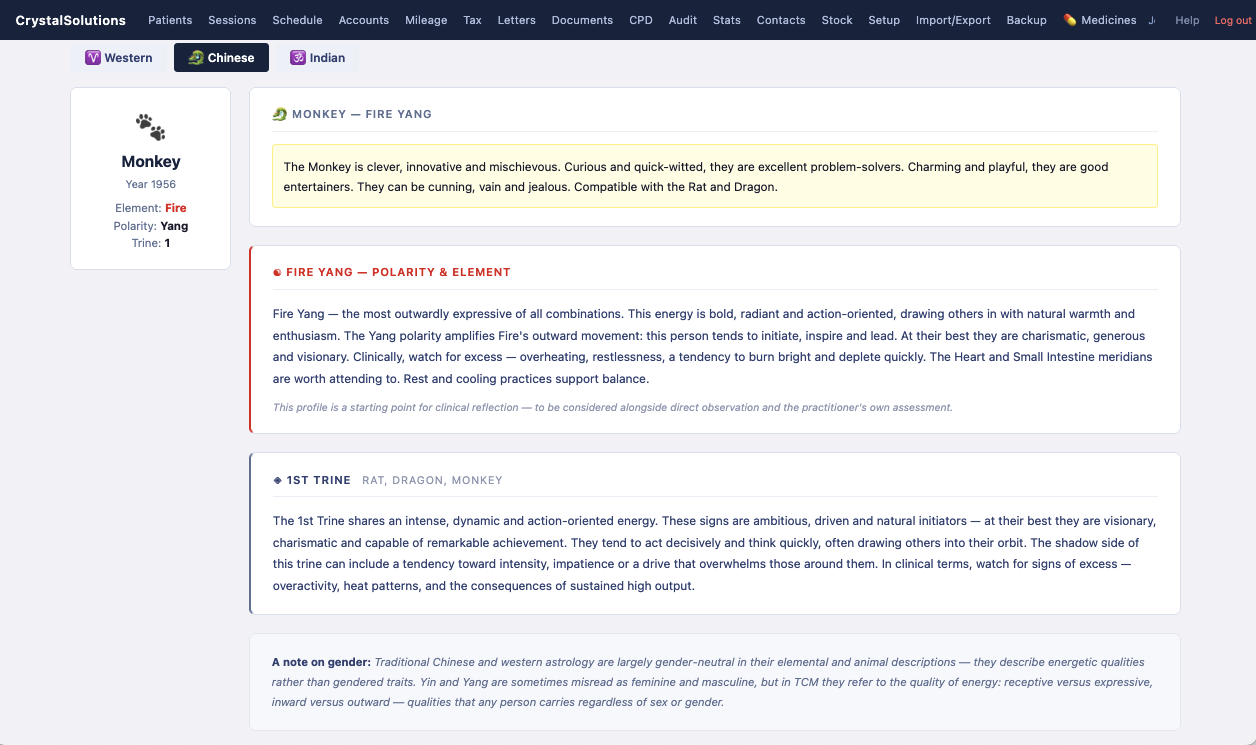
The Chinese zodiac is determined by year of birth, giving each person an animal sign, a five-element association (derived from a ten-year elemental cycle), and a Yin or Yang polarity. These three together — for example, Fire Yang Monkey — give a specific constitutional picture that is more nuanced than any one element or sign alone.
The module also shows the animal’s trine group — the three animals that share a fundamental energetic quality — which provides a broader constitutional context. Each of the four trines has its own characteristic pattern of strengths, vulnerabilities and clinical tendencies. A gender note is included, since Yin and Yang are sometimes misread as feminine and masculine — in TCM they refer to the quality of energy rather than sex or gender.
Western Astrology
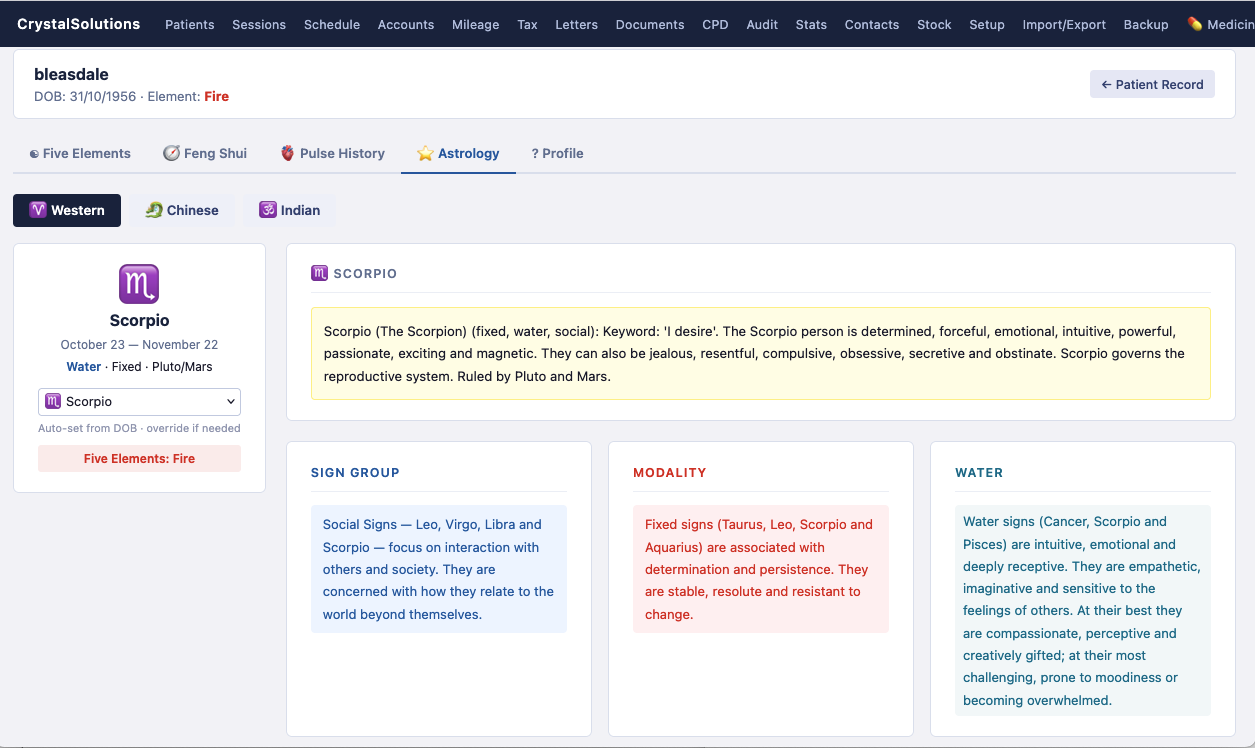
The western zodiac is determined by the date of birth. Each sign carries an element (Fire, Earth, Air or Water), a modality (Cardinal, Fixed or Mutable) and a sign group (Personal, Social or Universal). The module displays all three alongside a description of the sign’s character — and shows the western element and Chinese Five Element side by side, since these often differ and the comparison itself can be informative.
Indian (Vedic) Astrology
The module includes a correspondence table showing the western sign alongside its Indian (Jyotish) equivalent — the Rashi — and the Sanskrit element name. This provides a reference point for practitioners who work with Ayurvedic or Vedic frameworks alongside TCM or western astrology.
Applied Kinesiology and Muscle Testing
The Five Elements constitutional profile can be used alongside applied kinesiology and muscle testing as a framework for prioritising areas of clinical inquiry. When testing for food or material intolerances, environmental sensitivities or nutritional needs, the element and meridian associations highlighted in the profile can help direct testing toward the most clinically relevant areas for a particular patient.
This approach draws on a long tradition in integrative physical therapy of using constitutional frameworks to guide structured enquiry — using the Five Elements profile not as a diagnosis but as a map of where to look first.
A note on gender
Traditional Chinese and western astrology are largely gender-neutral in their elemental and animal descriptions — they describe energetic qualities rather than gendered traits. Yin and Yang are sometimes misread as feminine and masculine, but in TCM they refer to the quality of energy: receptive versus expressive, inward versus outward — qualities that any person carries regardless of sex or gender. The profiles in this module are offered in that spirit.
How it works in practice
Once a date of birth is recorded in the patient record, the Five Elements module is accessible from the action bar at the top of the record. The Chinese, Western and Indian tabs each present their respective profile automatically. The practitioner can review the constitutional picture, adjust the primary element if needed, note the likely meridian and organ associations, and save their assessment to the record.
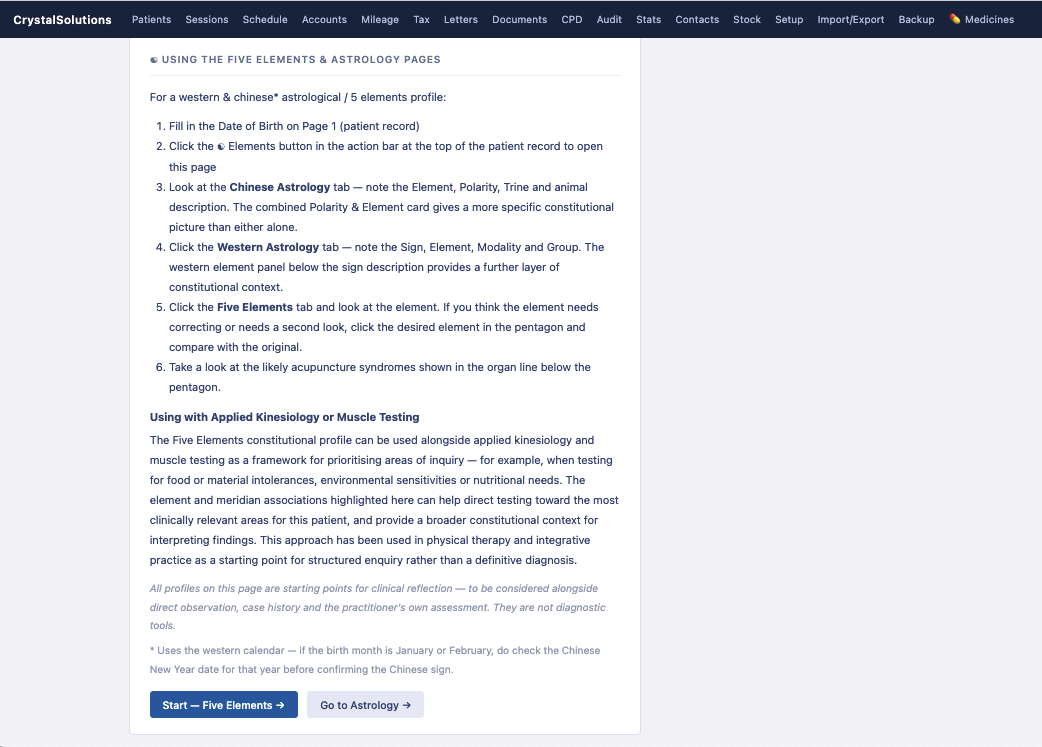
All profiles are presented as starting points for clinical reflection — to be considered alongside direct observation, case history and the practitioner’s own assessment. They are not diagnostic tools.
Available in
- CrystalSolutions — full holistic practice management
- PraxisClinic — streamlined practice management for newly qualified practitioners
Both include a free live demo with sample patient data so you can explore the Five Elements module before downloading.
You can also try the profile calculator right now — no login required: Five Elements & Astrology calculator →
CrystalSolutions & PraxisClinic ·
Privacy & Security Policy ·
Forum ·
SoulTrade Software