wow — as this is a rough notepad of a page i asked AI Claude to organise and categorise it to make it more useful and this link will take you to the resulting organised page called meadow-info.html (opens in a new page but very impressive with contents and headings to get you started (it did it in <5minutes which would have taken me days to do…
it isn't everything of course so scroll down for the complete hotch-potch with pics and diagrams

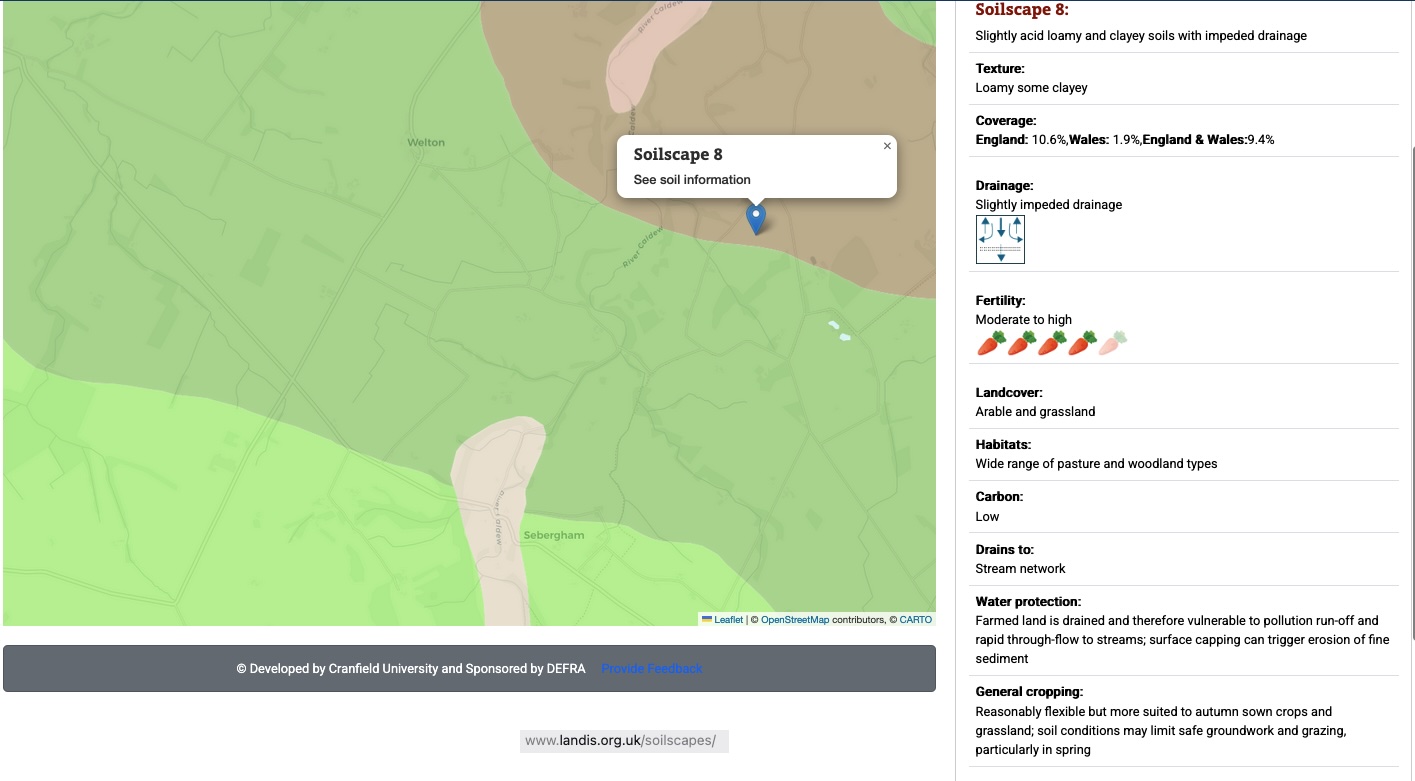
Soilscapes (Developed by Cranfield University and Sponsored by DEFRA) https://www.landis.org.uk/soilscapes/
ours is more 18 than 8 but these soil scape maps give a general idea of soils before a site visit/ soil sample and true evaluation
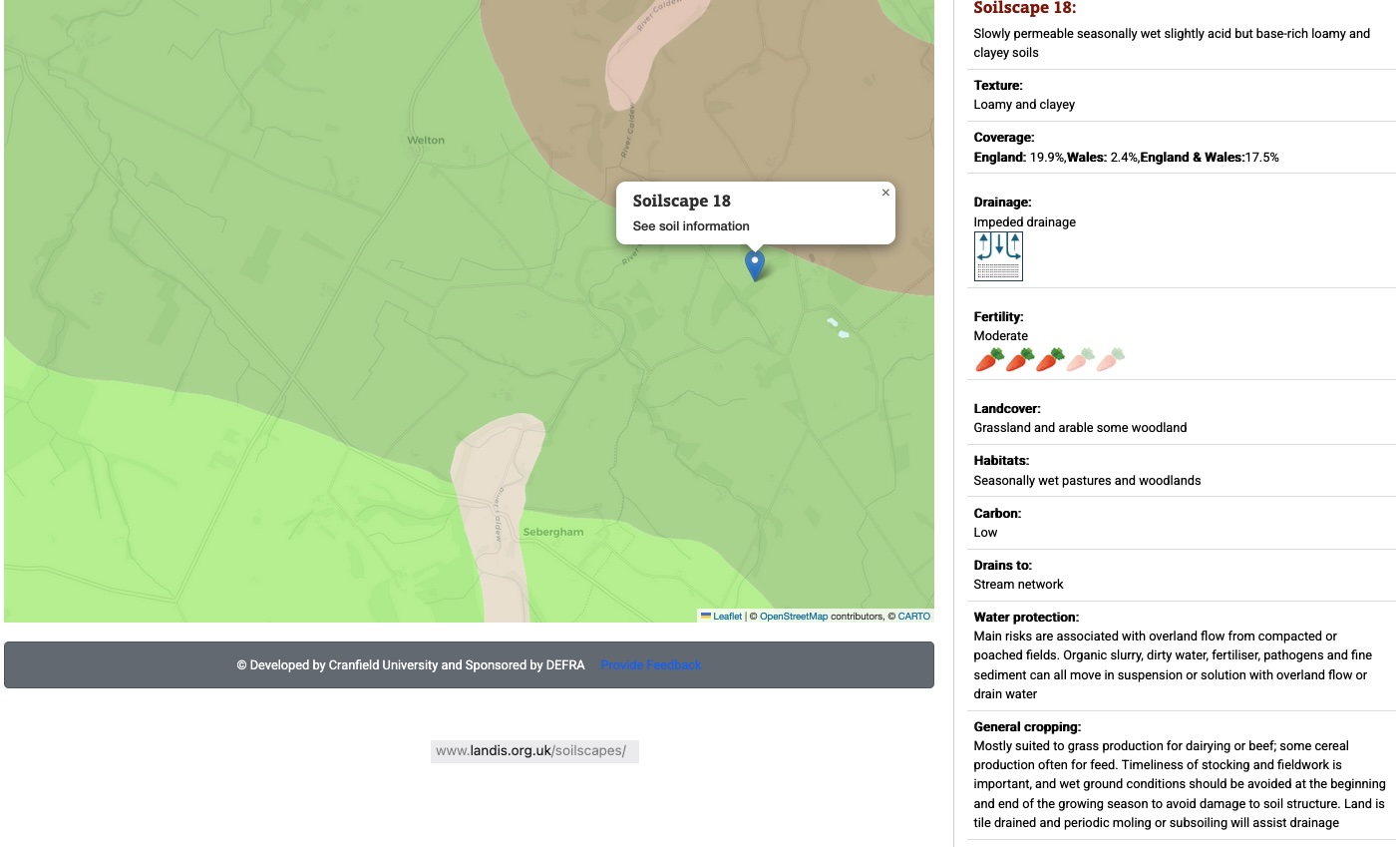
(click picture to zoom in new tab)
MAGIC stands for Multi-Agency Geographic Information for the Countryside.(useful for finding nearby meadow land (go to Layers/habitat/priority meadows) https://magic.defra.gov.uk/MagicMap.html
https://www.soilassociation.org/farmers-growers/low-input-farming-advice/soil-health/four-free-ways-you-can-test-your-soil-today/
https://ahdb.org.uk/knowledge-library/the-soil-health-scorecard
How to Create a Meadow, Matt Pitts https://www.youtube.com/watch?v=cF-K7Ce-NFo&t=436s
https://mix926.com/podcast/make-your-own-mini-meadow/
———-=====————
for any interested farmers wanting more info on regenerative farming, silvopasture -agriforestry etc click here
====
https://www.plantlife.org.uk/our-work/supporting-farmers-to-access-funding-for-grassland-restoration/
Planting for Pollinators
Recommendations for restoring or creating
a northern UK flower-rich meadow site pdf
Tanya St. Pierre, Cumbria Wildlife Trust
for any farmers out there who are keen to learn more about the many advantages of regenerative farming and putting it into practise, i’d recommend the following couple of links & videos esp starting with the trees 6/ and 5/ below
1/https://regenerativefarmersofuk.com/
2/Roots to Regeneration Webinar 3 2026-01-14
https://vimeo.com/1154399379/b9ae891a0e?mc_cid=13a65b9768 (start at 8mins!
3/https://rootssodeep.org/
4/ https://www.groundswellag.com/
(trying to find a particular excellent link that had 3 superb video farm case studies, but still can’t fid it, but on the way found these (in no particular order!
think i found it/them (2 videos) Three farmers, all at different stages of bringing trees into their farmed landscapes, share their motivations, methods, and results. Hear from: Phill Stead, Greater Poston Farm Neil Brown, Newhouse Farm Clare Hill, Planton Farm, Pasture for Life certified This film was made for Pasture for Life and the Shropshire Hills, Wye Valley, and Malvern Hills National Landscapes as part of Pasture and Profit. The film was funded by the Farming in Protected Landscapes programme.
5/ Trees in Our Farmed Landscapes https://youtu.be/GDac7WlLftk
and this beauty of a film from the soil association
6/ Agroforestry on upland farms in the UK https://youtu.be/UNU7ZEpOK_k
Three upland farmers talk about the benefits of giving their livestock access to trees and hedgerows, and why it's good for the animals, soil health, biodiversity, the environment and the bottom line. Meet Andrew Barbour from Mains of Fincastle in Perthshire, Glasnant Morgan from Pwllyrhwyaid Farm near Brecon in Wales and Freya Meredith from Lower Withecombe Farm on Dartmoor in Devon. We also hear from Luke Dale Harris, Innovative Farmers silvopasture trial coordinator from FWAG SW, and Kate Still from the Soil Association Farming Team. Supported by FABulous Farmers with Innovative Farmers (https://www.innovativefarmers.org/) and Soil Association Forestry
===
here're more links btw
https://www.regenerateoutcomes.co.uk/
https://www.plough.com/en/topics/justice/environment/regenerative-agriculture-in-the-lake-district
https://terrafarmer.co.uk/case-studies/
https://pastureforlife.org/sustainable-farming-agriculture-practice
https://rootsofnature.co.uk/the-principles-of-regenerative-agriculture/
https://www.innovativefarmers.org/knowledge-hub/
https://wilderculture.com/blog/
https://regenerativefarmersofuk.com/
https://protectorcactusworld.com/en/plum-plot-a-foray-into-silvopasture/
https://cactustreeguards.co.uk/products
====================
our Lidar aerial views
———-=====————
some initial notes when we arrived jan 2025 including copy/pastes from web trawling etc
grazing notes
questions
Water supply?
How many sheep/cattle and time period grazing?
1:100 days for cattle 1:23 days Sheep recovery of grass
Section off part of field for dog/protect rattle plugs etc - do you have any spare fencing?
We want better soil quality, biodiversity, better drainage and water retention
Don’t want muck spreading if we can mob graze
who cut hedges in jan ?
which hedges?
can we come and see your setup too?
Research has shown that grazing at 9-12cm had more than twice the number of larger insects than grazing at 6-9cm.
https://farmwildlife.info/how-to-do-it/livestock-enhancing-improved-grassland/
Consider introducing seeds in phases as some plant species are much easier to establish than others. For example, yellow rattle could be used initially to reduce the vigour of grasses for a later introduction of wildflower seed.
https://farmwildlife.info/how-to-do-it/flower-rich-habitats/livestock-wildflower-rich-grassland-restoration/
The priority, and also the easiest and most effective option is to work on existing grasslands that have lost some of their plant diversity but still retain a number of native grasses and flowers. Small changes to existing grazing or cutting management may be all that is needed. For example allowing existing plants to flower and seed, and providing small areas of bare ground (by cattle grazing or chain harrowing) for seed germination may increase the abundance of wildflowers. Using targeted grazing to tackle rank areas and grass dominance can also be effective.
we need to test now
https://www.soilassociation.org/farmers-growers/low-input-farming-advice/soil-health/four-free-ways-you-can-test-your-soil-today/
https://ahdb.org.uk/knowledge-library/the-soil-health-scorecard
1/we want to find out what we have
what kind of grasses & plants
previous short or semi intensive grazing may have suppressed certain grasses plants that may appear? — see below
2/we want to improve the soil (stewardship)
increase bio-diversity, insect life , pollinators , butterflies etc
(without ploughing / reseeding)
but using an initial smallish area (<¼ acre probably fenced off) where we will plug with yellow rattle (2x £50 )
the rest of the field (except the bottom area — that can be grazed autumn& winter)) can be early mob grazed 1-2 days then left for 21 days or ideally a month)
3/ we understand you are busy/that it is your livelihood
that moving the sheep or cattle is time consuming
however there would be no charge
and in future years there would be a richer fodder
+ we all perhaps will see more insects flowers birds etc
already we have secured a grant for planting a hedge (and trees -wild cherry)next autumn/winter to go along the line of the barbed wire fence separating the bottom end of the field — the wet area!
=====4/we wanted to avoid muck spreading as i feel there is already enough of that happening round here! ++ that means less work for you
in future years we can collect our own yellow rattle seed and spread it to more of the field)
after a cattle trample in a wettish early spring 1 or 2 years in ==we could then perhaps sow some extra meadow seed (as we suspect we may be variety sparse)
for testing see
https://www.soilassociation.org/farmers-growers/low-input-farming-advice/soil-health/four-free-ways-you-can-test-your-soil-today/
Get yourself a spade (or a mole)!
It’s the best investment you will ever make. Take it into the field and use it to dig a hole. Look at how your soil is structured – whether it breaks apart easily or takes more effort. Look at what your plant roots are doing and whether the soil is holding water.
Count your worms
Our soils are alive and comprise of millions of different species within them most of which are impossible to see. Worms are a good indicator species – as if you have lots of worms – your soil will be in good biological condition! Its not just quantity – you can also look at the types of worm that you have
Complete a slake test
Choose a field and take a sample of soil from 10cm below the surface. Dry it out on a windowsill or airing cupboard for up to 2 days. From the sample, remove an aggregate (a small clump), about the size of a marble. Drop it in a glass of clean water. The indication is that the longer it remains undissolved, intact, the more carbon it contains. You can repeat this across the farm, making note of where and when you sample. Consistency is key.
Complete an infiltration test
The ultimate aim is to get your soil to act as a sponge. When your soils are in good health they will hold water and release it for crop growth. Get an amount of water and look at how long it takes for the water to infiltrate into the soil. If the water sits on the surface – this can indicate compaction.
====
https://www.fwi.co.uk/livestock/beef/what-is-holistic-grazing-and-what-are-the-benefits
Mimicking the natural behaviour of herds and wildlife and the way they graze land could help farmers increase their grass productivity by up to 300% without expensive inputs and reverse climate change.
In practice, animals move from paddock to paddock mirroring the natural herding behaviour of animals. Grazing involves longer rotations of ideally 30+ days, which gives grass time to fully recover before being regrazed.
The grass is grazed for short periods and longer grass is trampled, incorporating organic matter into the ground. The manure is also spread more evenly.
It is, however, different from mob and rotational grazing, as those systems don’t take in to account the time needed for certain species of grass to fully regenerate, wildlife habitats and the water, mineral and energy cycles (see table below).
What are the benefits?
Leaving the grass to rest for longer periods builds resilience in the soil. More energy is harnessed from photosynthesis, creating a stronger and deeper root system.
This improves water infiltration and storage capacity, reducing flooding as well as making the grass more drought-tolerant.
“Well-managed livestock are earth’s natural regenerators. When you regenerate soil, the entire ecosystem works more effectively. Wealth starts with the soil,” he said.
Mrs Cooke said farmers can increase the amount of fresh grass per acre from 635kg to 2721kg by switching from set stocking to holistic grazing.
She said: “Grass is not adapted to be set stocked. If plants are severely grazed, they shed their roots as the plant is not getting as much energy from photosynthesis.”
https://www.fwi.co.uk/livestock/beef/what-is-holistic-grazing-and-what-are-the-benefits
Key points to consider (from sue everett’s meadow page)
How big is it?
Is the meadow a field? Then you need grazing animals and, ideally, a means of mowing and taking off the ‘hay’.
Is the meadow part of your garden? You will need to be able to cut the vegetation several times and remove it after it has been cut in the summer.
What’s been done before?
Having a knowledge and understanding of the past management history will help you to work out what may need to be done. For example, fields that have been agriculturally improved (fertilised, weedkilled and/or resown with agricultural grass varieties) may have no viable seed bank of either wild flowers or grasses, and seed-rich green hay or other suitable native seed may need to be introduced. However, if it’s very fertile, this could make restoration more difficult and lengthy.
What is the existing wildlife value?
Before embarking on what could be quite drastic interventions make sure you understand if there is any existing wildlife value to the land. This could be for wild flowers, breeding birds, amphibians and reptiles and wild flora. What you find may dictate what you decide to do, where and when. Seek advice from someone who can help you with this, such as a local ecologist or the local wildlife trust may help you.
What’s growing now?
Armed with a good wild flower book (or assisted by a botanist from Moor Meadows) make a list of the grasses and wild flowers that are present, ideally in late June. Try using the simple grassland survey approach published by Natural England in the Higher Level Stewardship Farm Environment Plan (FEP) Manual (Section 2.5, p.55) to identify whether the grassland is already species-rich, semi-improved or improved.
If the grassland has been kept very short: Sometimes there’s lots of wild plants, but they’ve just got suppressed by overgrazing or frequent mowing. Just relaxing either for a window of 6-8 weeks may reveal all sorts of goodies. If it’s your lawn, then just slacking off the mowing for this time might be all you need to do, before returning to your routine mowing – if lots of flowers suddenly appear, there’s not much to do other than get the grazing and mowing right. If there are few flowers, then the grassland may need more help to recover. Many agricultural fields come into this category, having been “improved” for farming – cultivated and re-seeded or the grassland sprayed with weedkillers or treated with fertilisers – activities which may have wiped out the original diversity of wild plants and impoverished the seed bank.
If the grassland hasn’t been grazed or mown, or is tussocky, weedy or is becoming invaded by bramble or bracken: The likelihood is that many wild flowers have been shaded out by taller grasses and other species. The immediate priority will be to restore suitable grazing and/or mowing, to reduce the quantity of tussocky vegetation. Topping rush, tussocky grass and bracken, and using mattocks to get out bramble, may be necessary. Creeping Thistle can be controlled by pulling but larger stands may need to be spot-treated with herbicide. It is important to understand that most herbicides will cause collateral damage to a range of wild flowers – a quad-bike mounted boom spray if used is likely to kill many species, not just thistles. However, extreme weediness may need extreme measures; if there’s no meadow flowers, complete destruction of the existing grassland may need to be considered. This normally involves herbicide treatment of the existing sward, followed by a repeat treatment or cultivation, before re-seeding with a suitable seed mix. Weeds germinating from the seedbank after cultivation will also need herbicide treatment prior to seed introduction.
What’s your soil and the land characteristics?
It can be worth testing the soil – if it’s high in nitrogen and phosphate, then restoration will take time and be more challenging. The soil type and pH will vary depending on the underlying geology and location in the landscape. Identifying the land capability and characteristics will dictate what you will do and what might be achieved. For example, north-facing slopes will not necessarily ever be flower-rich. There will be different outcomes expected and possible for fields on wet ground, well-drained limestone or sandy soils. Soils high in nitrogen or phosphate may also be more challenging to restore and for these it is usually advisable to repeatedly crop off the grass, while applying no fertilisers, for at least five years before embarking on any further action.
from the excellent Sue Everett https://moormeadows.org.uk/information/meadow-creation-and-management/how-to-restore-a-meadow/
==
mob grazing or tall grass grazing
from Grassland guide: Going back to basics with mob grazing
http://www.farmersguardian.com/4117778
Another regenerative grazing strategy which is potentially the next step after rotational grazing in terms of soil health, is mob grazing.
AHDB's senior knowledge exchange manager and national specialist in grass forage, Katie Evans says mob grazing which is sometimes referred to as tall grass grazing, is ultimately where a high density of livestock is grazed over a short period of time, coupled with long rest periods.
The key difference from rotational grazing is that mob grazing includes longer rest periods and higher grass covers, says Ms Evans. She explains one of the key benefits of implementing a mob grazing system is the improvement in soil structure which helps to build resilience in periods of dry or wet weather, due to the deep rooting structure of the swards.
Click here to read the first part of our grassland guide on understanding soil health.
The other benefit from a soil perspective is the storage of sugars in the roots which builds soil carbon and improves organic matter. Ms Evans says: "It is down to soil health as to why you would practice this type of grazing, to begin improving soil structures."
While mob grazing may sound very similar to rotational grazing, Ms Evans says grass covers will be much higher than in a rotational system, as well as a difference in sward varieties.
In a mob grazing system, multi-species swards and herbal leys are usually used over permanent pastures due to their rooting systems and plant diversity.
Looking after the livestock both above and below ground is a key element of mob grazing, which is why the approach graze a third, trample a third and leave a third is a founding principle of the system.
In practice the principle refers to livestock grazing a third of the paddock, trampling a third of the grass cover into the soil and leaving a third of the cover standing.
"By trampling a third of the grass cover it helps to feed the microorganisms in the soil, while increasing the soil's organic matter content and structure," says Ms Evans.
Click here to read the second part of our grassland guide on optimising muck and fertiliser use.
She explains during a drought period leaving a third of the sward and trampling a third is very beneficial as it gives the soil protection to retain moisture more easily.
Additionally, by leaving a third of the sward untouched, the leaves act as solar panels capturing the energy and allowing grass regrowth and regeneration to begin sooner.
When looking to implement a mob grazing system, Ms Evans says there are no hard and fast rules and no one size fits all.
As grass covers and livestock demands differ from farm to farm, an understanding of each farm's paddock sizes, livestock requirements and grass growth rates is required before making decisions on paddock numbers, group sizes and grazing times.
However, it is common with mob grazing that livestock are run as bigger groups, compared to rotational grazing which are split up into multiple groups.
Ms Evans adds: "For example, in a mob system a herd of 100 suckler cows and calves run as one group, and the length of time they stay within the paddock would be dependent on their size, the paddock size and the pressure applied to the sward."
from Grassland guide: Going back to basics with mob grazing
http://www.farmersguardian.com/4117778
===
visit
https://meadows.plantlife.org.uk/3-maintaining-meadows/managing-a-flower-rich-pasture-with-grazing/mob-grazing-for-diversity/
https://www.youtube.com/channel/UCLOjnx-L6bYUwysLggv0GsQ
https://moormeadows.org.uk/information/meadow-creation-and-management/how-to-restore-a-meadow/
https://forum.meadowmakersnetwork.org.uk/viewtopic.php?t=290
https://meadows.plantlife.org.uk/3-maintaining-meadows/managing-a-flower-rich-pasture-with-grazing/mob-grazing-for-diversity/
https://www.fwi.co.uk/livestock/beef/what-is-holistic-grazing-and-what-are-the-benefits
https://www.google.com/url?sa=t&source=web&rct=j&opi=89978449&url=https://farmwildlife.info/how-to-do-it/existing-wildlife-habitats/flower-rich-grassland/&ved=2ahUKEwjmn9TmqaKMAxWoXEEAHVRoEWwQFnoECCAQAQ&usg=AOvVaw1egaXvIGyb-kzoW8gCgd81
www.magnificentmeadows.org.uk/advice-guidance/how-can-i-manage-my-meadow/managing-for-grassland-habitats
bumblebeeconservation.org/images/uploads/Resources/BBCT_Land_Factsheet_3_Managing_wildflower_pastures.pdf
===
we’ve bought 50 yellow rattle plugs (£100)and some clay loving seeds and will get some plugs too another £100
we will need to fence this area off whatever we do so have also bought 50m of stock fencing etc
we intend using the seed from these plugs to repopulate more areas as years roll on..(eg after a late summer/autumn flash short trample graze esp with cattle (then sheep cld mob it if late autumn growth allowed?
Decide whether we fence off to new hedge now or later and agree to mob grazing when sword gets longer and then let it rest for at least 21 days depending on growth & weather
leave muck spreading for now but can decide on this as & when we need to
be best if the beasts do it for us!
sent a note about costs of fencing off the rattle
morning — we had our neighbour the farmer who had been using the field round y’day wondering what we are wanting to do going forwards — i told him how i wld like to find out what species we have and mentioned mob &holistic grazing increasing root depth soil health biodiversity insects b’flies plants & birds the usual ecological dream!! etc as he has his own pasture — sufficient i think — ideally we want to start immediately with a small area (c1/4-½ an acre) and plug it with some yellow rattle (can u send me the name of the local seed place you mentioned btw ) anyhow i wondered what it might cost for you to help me put up a temporary stock fence — squared wire not barbed —or even plastic - as stock wldn’t be in the field for long — 1-2days — probably about a 100-150 metres in a diagonal near the new gateway where we could protect the plugs until we can gather their seed (which i’d use to spread incrementally in future years) — thinking that if, as i suspect the field is variety sparse we may then be able to use meadow seed after a short cattle trample one spring in the future. wld welcome your thoughts if u get a chance — we have agreed to meet in a week and we will give them our neighbours a better idea of what we are aiming to do and whether they were interested — they’re so busy lambing at the moment and i think they are generally up against it time wise so don’t want to to ask or lumber them with stock moving but they wld get free use and in future years richer more diverse fodder —looking at increasing grazing heights (eg at 9-12cm u get more than twice the number of larger insects than grazing at 6-9cm.) 1-2 days grazing with at least 21 days pasture recovery — probably longer to begin with (if u were interested i cld send u my notes — we don’t want to plough and seed a meadow — we want to gently increase existing diversity — see what’s there at present and i told him i wanted to avoid muck spreading as i feel there is already enough of that happening round here —+ that means less work for him etc etc sry to hit u with all this — have a great sunny week and thx for your help on saturday
==
£54.30 per 50 metres 50m L8/80/15 Stock Fencing Sheep Pig Cattle Livestock Fence Galvanised Wire Mesh
or with posts and wire etc & 50 metre roll (https://www.ebay.co.uk/itm/403782724418
15 of 1.65m x 75mm Posts (5FT3 Tall) £276
or
10 pack Round Fence Post | 1.65m x 75mm | 10 Pack
https://www.ebay.co.uk/itm/222987736511 £75
or
500 metre of electric wiring fencing https://www.ebay.co.uk/itm/266828059205
Reel Post 500m Electric Fence Kit Doblit QuickFence 120cm 3 Reel Fencing Post £214.99
+https://www.ebay.co.uk/itm/265786796057 Rutland ESS400 Electric Fence Solar Energiser 0.43J 2km 3w Panel Portable £210
or Gallagher S12 Solar Energiser Electric Fence 0.12J 1.2km 2.2w Panel Portable £169
or Gallagher SmartFence 2.0 - 100m All-in-One Mobile Fence
£274.00
£249,
00
Including taxes Excluding shipping
https://www.electricfence-online.co.uk/gallagher-smartfence-20-mobile-fence.html
===
hay scenario (split reward)
future scenario where we had to make good an exorbitant land price
Rule of thumb is that one tonne of hay is equal to approx 40/45 bales or 4 to 5 round bales and one acre would yield approx two tonnes of hay.
(altho just 1 cut would hopeful be species rich & good quality)
some recent prices (2025 from https://forums.horseandhound.co.uk/threads/cost-of-hay-on-a-livery-yard.844002/
small bales only at I think around £5.50 a bale,
I pay £45 for a round of haylage from a farmer
£38 a lg bale
buying rounds at £50.
£35 a bale from a supplier we chose who delivered me two at a time.
£56 for 8ft bale
£4.50 a bale (small)
so for ease 40 x £5 = £200 an acre
field is 6.5 acre but 1.5 is sedge/rounds and reed
so approx £1000 for 1 cut of hay — less cut store time etc (then a quick 1-2 day trample/graze every 21 days o’er autumn winter— hopefully more variety spread —as seed spreads
cld perhps eventually yield 2 cuts £2000 less expense or share— years on (if some cash was needed)and then only £1000
===
or land rental
The cost per acre for rough mixed grass grazing in my area on medium quality land is no more than €100 per annum. That’s with a water supply, boundary fencing, and gated access. For land without any fencing, decent grass/mostly weeds, no water supply, it’s not worth more than 50 per annum due to work/costs of making it suitable.
https://forums.horseandhound.co.uk/threads/hello-new-here-and-in-need-of-advice-please.800613/#post-14528935
A 5 acre field rented out for horses is worth a lot more than this. There would also be a queue of people after it.
it depends on the field. Not all fields are equal. Theres 5 acre fields on clay that are complete mudpits right now and 5 acre field on loam that are stocking a good number of animals and providing grazing.
i quoted my area per acre/per soil type. It’s vastly different depending on land type and area - and of course in the UK the demand for grazing land is very high, so even a terrible field will attract customers, until the field gets completely trashed, and they move on.
£100 pcm seems to be the going rate for just a field based grass livery. It would be pretty much unheard of for liveries to buy and install a shelter when on a monthly livery contract. I also wouldnt entertain any sort of livery if it didnt have post and rail perimeter fencing. Splitting it with electric is fine, but you do need proper fencing around the outside.
so at these prices from 5 yrs back approx £1k a year per acre which cld be £5k? horses
but sheep say £50 an acre per annum-==£250 pa!!
so Qu what wld u pay as rent ?
Sheep grazing rent per acre can vary significantly based on location, land quality, and grazing period, but generally, you can expect to pay around £65 to £90 per acre for six months of summer grazing, with potential for higher rates for higher-quality land and facilities
The average value of pasture land is £7-£8,500 so £40k wld be the top but then it’s clay and only 5 acres useable so £—K is the very top == we value it here as £— top
local farmer valued the whole field at 7k!!
===
Hi Char
I hope you are well, i am not too far from You in Bramham near Wetherby.
i rent land at the moment for sheep at the start 4 years ago i paying £500 per year for 5 sheep which i know is astrnomical, this was a means to an end and the guy could have gopt a lot more if renting out to horses.
since then i still keep this land and pay thge same amount but i also have the option of 28 acres of free grazing from 4 differnt people and 43vsheep so the average cost for me has come down alot
the people offering me free grazing helps them as much as me and i often give them a side of lamb to helo swweeten the agrement to graze the following year.
this might not help much but it depends what angle you are coming from if its an extra source of income then you may struggle with farmer/smallholder grazing sheep to make that income.
if it is just to get the grass down to save time and effort getting the tractor out or a contractors to cut it then finding someone local and doingeach other a favour.
as other people have mentioned depends on fencing water etc and how longthe grazing is.
regards
Ryan
===
Hay meadows are grasslands that are left to grow over the spring and summer and are cut for hay.
Traditional hay meadow management works well on larger meadows if you have access to machinery for hay-making and livestock for grazing. Once the plants have flowered and set seed, the meadows are cut for hay between July and September. The hay is dried and baled and the meadows are then usually ‘aftermath’ grazed if livestock is available. This helps tread seed into the ground and reduces grass growth over winter so wild flowers have space to spread and germinate. The annual management cycle for hay meadows looks like this:
When to cut hay
Hay is cut from mid-July to September depending on weather and the wild flowers present. Alternating between earlier cuts (usually after mid-July) to later cuts (late August or early September) is beneficial. Leaving unmown strips along the edges of fields provides a food resource for insects, especially butterflies and bumblebees. These margins and plots could be swapped around each year so that they do not become swamped with more competitive grasses.
The hay is cut, usually with a tractor mounted drum or disc mower, and spread out to dry. It is ‘tedded’, meaning turned, at least once a day to dry the crop. This also has the advantage of loosening any seed that still remains in the flower heads, particularly yellow rattle, so that it falls out onto the ground. When the hay is dry, which is usually after 3-5 days, and once any dew has dried in the sun, it is baled and taken away for storage and use over the winter. There are several types of bales: round, large rectangular and small rectangular. Unlike straw, hay is not wrapped but if the weather is damp during the cut or when it is drying, haylage may be made instead of hay, and this is usually wrapped in plastic so that the grass can ferment slightly.
Aftermath Grazing
A few weeks after the hay is cut and baled, the new grass growth can be grazed. There are three benefits of aftermath grazing: livestock break up any matted vegetation and mosses, push seeds onto the soil helping germination, and eat down the grass growth before the wetter autumn and winter weather, allowing light to get to the ground and aiding wild flower germination.
The types of animals and levels of grazing vary for each type of grassland and is estimated at 1-2.25 LU/Ha. Grazing may be extensive with around 1-1.5 LU/Ha (a low number of livestock may be allowed to graze for a longer period of time) or pulse or mob grazing may be used with 1.5-2.25 LU/Ha (a short intensive burst of grazing before removing the livestock).
The aim is to reduce the height of the vegetation to 2-10 cm before the end of the winter but without causing poaching (where cattle, ponies or sheep leave pock-marks with their hooves in grassland, particularly after wet weather). A little poaching can be helpful as it creates bare ground, but large areas denude vegetation and can cause damage, particularly compaction, which can increase the spread of problem plants, such as docks (Rumex sp.). Livestock should be removed from the field if there is very wet weather or if poaching in gateways or along fence lines starts to become apparent. If grazing is not an option If grazing is not possible, a mat of vegetation can build up (thatch) and mechanical removal using chain and tine harrows will be necessary. The thatch should be removed so that it does not decompose adding nutrients back into the soil and affecting the growth of wild flowers and grasses. Harrowing can either be undertaken in the autumn in damper fields, or in late winter or early spring in drier fields.
Autumn – Winter
If the autumn and winter are relatively mild and dry, light grazing (with 1.5-3 Livestock Units (LU) per hectare) can continue until March. This helps to remove any early growth that could swamp wildflowers later in the year. If livestock are not available, grass growth can be controlled by cutting and removing the clippings over the autumn and winter in all but the wettest periods. Autumn harrowing will help remove the thatch.
In a normal year, livestock should be removed around the end of February to allow early wild flowers, such as cuckooflower / lady’s-smock (Cardamine pratensis) and cowslip (Primula veris), to bloom. The meadow should remain ‘shut up’ throughout the spring and summer and until the plants have flowered and set seed.
==
clay soils suffer more from impaction preventing root intrusion
Clay soil is sticky and will hold its shape. It retains moisture and nutrients, but has poor drainage and can impede root penetration when too compact or dry.
fence distances to protect plugs
38 feet from gate to hedge —up to 50 feet so maybe 10 to 15 metres approx
diagonal section was anything <> was 52 foot
so i cld use a 50 metre stock fence with 10 larger poles and my skinnier poles to complete
or green plastic fencing with existing poles if no stock till seeding
long fence from road hedge to barbed wire fence 150 metres 452 feet
===
https://meadowmania.co.uk/products/wildflower-plants-for-clay-soils
https://growingformarket.com/articles/strategies-farming-clay
https://growingformarket.com/articles/strategies-farming-clay
https://thefarmingforum.co.uk/index.php?threads/options-for-heavily-compacted-clay-soil.201706/page-2
https://youtu.be/yExpSwpRkEs
==
metal estate fencing £30 metre used in skem on ebay!
==
posts every 4 metres so 12 for 50 metres
cld use spikes and 3x3 for control posts
===
some rebanks notes — basically allowing grass sword to remain longer for more solar energy (feeding sugar carbon to roots and soils etc which in turn allow longer roots to access minerals water etc more easily
eg https://x.com/herdyshepherd1/status/2004843032999510463?s=20
Grassland math A truly regenerative or simply good farm adds more energy/nutrients than it takes away And it’s entirely possible because of photosynthesis, root exudates and the soil food web Green plants eat sunlight and are carbon pumps downwards, if managed longer to be so
Green plants give away between 20-50% of the carbons and sugars they convert from sunshine and push them down to the soil food web Herbivores take 10% of what they eat to grow 90% is returned And the plants left longer can exceed the 10% easily
A genuinely regenerative system means more energy is added to the system through photosynthesis than taken by the farming
My whole job is to manage solar every(energy) flows to maximise them If I do my job right the system isn’t mined - it is being rapidly replenished with carbon and sugars and water and other nutrients Which is why it grows more each year not less
===+++++=====
hedge maintenance & courses etc
https://www.cbdc.org.uk/get-involved/cumbria-ecoskills/
https://www.ticketsource.co.uk/whats-on/penrith/eden-valley-location-tbc/hedgelaying-workshop
eg https://www.westcountryhedgelayer.com/hedge-restoration
"A ministry of agriculture film from 1942 showing the process of laying a hedge. By this time, with the labour force fighting abroad, the craft was already in decline. The coming decades would see agricultural practices increasingly mechanised and much old war machinery was repurposed and used to clear the land for more intensive cultivation. The years after this film saw half of Britains hedgerows lost. Now we work again to reinstate what was lost in those years.."
https://www.instagram.com/p/C_XLHp1KT7g/

the Oxford Real Farming Conference (ORFC) brings the real food and farming movement together every January.
An alternative farming conference
ORFC attracts farmers, growers, activists, policymakers and researchers from around the world who are interested in transforming our food system.
the latest 2026 session videos not yet online but the previous years are available here
this was a good random one to start with 3 short presentations with a q&a
https://orfc.org.uk/session/permaculture-design-for-water-retentive-resilient-and-productive-landscapes/