Before doing anything, it pays to know what you're working with. Soil type, existing plant diversity, and land history will shape every decision that follows.
1.1 — Soil Types & Mapping
The Soilscapes tool (developed by Cranfield University, sponsored by DEFRA) gives a useful starting map before a site visit or soil sample. Our land is closer to type 18 than type 8, but the maps provide a good general orientation.
Multi-Agency Geographic Information for the Countryside. Go to Layers → Habitat → Priority Meadows. magic.defra.gov.uk
LiDAR Aerial Views
Our own LiDAR and Google Earth land-area maps showing field boundaries, acreage, and terrain detail.(see Notes)
1.2 — How to Test Your Soil
Four free methods you can do today — no lab required. Results will tell you about compaction, drainage, carbon content, and biological health.
Spade Test
Dig a hole. Look at structure, root behaviour, and whether the soil holds water. Count your worms — they're a reliable indicator of biological condition.
Slake Test
Dry a marble-sized soil clump, drop it in clean water. The longer it stays intact, the more carbon it contains. Repeat across the farm for consistency.
Infiltration Test
Pour water on the soil and time how long it takes to absorb. Water sitting on the surface indicates compaction. Aim for the soil to act as a sponge.
Before making any drastic interventions, understand what's already there. Fields that have been overgrazing or frequently mown can suppress wildflowers without eliminating them — simply relaxing for 6–8 weeks in summer may reveal unexpected diversity.
"If lots of flowers suddenly appear, there's not much to do other than get the grazing and mowing right."
— Sue Everett, Moor Meadows
Key questions: What grasses and plants are present (ideally surveyed late June)? Has the land been fertilised, weedkilled, or resown with agricultural varieties? What's the grazing history? Consult a local ecologist or wildlife trust before significant interventions.
The goal is to gently increase existing diversity — finding what's already present and building on it — rather than ploughing and reseeding from scratch.
2.1 — Starting Points: Grassland vs. Arable Conversion
The approach differs significantly depending on your starting point. Grassland that's been "improved" (fertilised, weedkilled, resown) may have no viable seed bank and need seed introduction. Arable conversion involves different timescales and challenges.
Our conversion context: Previous short or semi-intensive grazing may have suppressed grasses and plants that could reappear naturally. Priority is to find out what we have before intervening further. The bottom wet area can continue as autumn/winter grazing while we focus restoration on the main field.
Yellow rattle is the critical first step — it parasitises coarse grasses, weakening their dominance and creating space for wildflowers to establish. We bought 50 plugs (2 × £50) and fenced off a small area to protect them but unfortunately we had a drought and our hope that we could build from this failed, so we switched to a deferred grazing regime instead in order to improve soil, worms, root depth and diversity see our section on deferred grazing below.
Year 1–2
Fence off a small area (~¼ acre). Plant yellow rattle plugs. Mob graze the rest for 1–2 days, then leave 21+ days to rest.
Year 2–3
Collect yellow rattle seed ourselves and spread to more of the field. After a cattle trample in an early spring, consider introducing additional meadow seed.
Ongoing
Rattle spreads incrementally. Avoid muck spreading — let the livestock do that work for us, and maintain no-fertiliser policy.
Clay soils retain moisture and nutrients well but suffer from compaction, which impedes root penetration. Soil high in nitrogen or phosphate from past fertilising will take time to restore — repeated cropping off the grass with no added fertiliser for at least five years is usually advised before further seed introduction.
Clay notes: Clay soil is sticky and holds its shape. It retains moisture and nutrients, but has poor drainage and can impede root penetration when too compact or dry. Consider introducing seeds in phases — yellow rattle first to reduce grass vigour, then a later introduction of wildflower seed.
How livestock are managed is as important as what's planted. The aim is to use animals as natural regenerators — building soil health rather than depleting it.
3.1 — Mob Grazing & Rotational Grazing Explained
Mob grazing places high livestock density on a paddock for a short period, then leaves it to rest for a long time — typically 30+ days. The key principle: graze a third, trample a third, leave a third.
Graze a Third
Livestock eat one third of the sward for nutrition.
Trample a Third
Grass is trampled into the soil, feeding microorganisms and building organic matter.
Leave a Third
Standing grass acts as a solar panel — capturing energy and allowing faster regrowth. Protects soil moisture in drought.
Research shows that grazing at 9–12cm supports more than twice the number of larger insects compared to grazing at 6–9cm. Leaving grass to grow longer before grazing also builds deeper root systems — feeding more carbon and sugars to soil organisms.
"Well-managed livestock are earth's natural regenerators. When you regenerate soil, the entire ecosystem works more effectively. Wealth starts with the soil."
"Green plants give away between 20–50% of the carbon and sugars they convert from sunshine and push them down to the soil food web. Herbivores take 10% of what they eat to grow — 90% is returned."
— James Rebanks, @herdyshepherd1
Our plan: 1–2 days grazing with at least 21 days (ideally 30+) pasture recovery. No muck spreading — let the beasts do it naturally. Fence off bottom wet area as autumn/winter grazing, rest the upper field through spring and summer. Cattle:sheep ratio approx 1:100 days cattle / 1:23 days sheep for grass recovery.
3.3 — Hay Meadow Annual Cycle
For larger meadows, the traditional management cycle works well — and with some adjustments, supports high wildflower diversity alongside productive hay.
Spring (Feb–July)
Remove livestock by end of February. Meadow "shut up" through spring to allow wildflowers to bloom and set seed.
Summer (July–Sept)
Cut for hay mid-July to September depending on weather and species. Ted daily to dry. Leave unmown margins for insects.
Autumn/Winter
Aftermath grazing — livestock trample seeds into ground, eat down grass before winter. Remove if very wet to avoid poaching.
Rule of thumb: one acre yields approx 2 tonnes / 40–45 small bales of hay. Current prices circa £4.50–5.50 per small bale, £38–56 per round bale.
Trees and hedges are not separate from the meadow — they're integral to it. Shelter, biodiversity corridors, soil stability, livestock health, and carbon all improve when trees re-enter the farmed landscape.
4.1 — Hedge Laying & Maintenance
We've secured a grant for planting a hedge (and wild cherry trees) along the barbed wire fence line separating the wet bottom end of the field — planned for next autumn/winter.
Three farmers at different stages of bringing trees into their farmed landscapes share their motivations, methods, and results — a compelling picture of what's possible.
Several funding streams exist specifically for grassland restoration and agroforestry. The Farming in Protected Landscapes programme has been particularly active in supporting projects like ours.
We need approximately 100–150 metres of temporary stock fencing to protect the yellow rattle plug area (diagonal from the new gateway). Options range from standard stock fencing to electric systems.
Stock Fencing
L8/80/15 galvanised wire mesh — approx £54.30 per 50m roll. Posts every 4m, so 12–13 posts per 50m. 1.65m × 75mm posts at £276 per 15 pack.
38–50ft from gate to hedge. Diagonal section approx 52ft. Long fence road hedge to barbed wire: 150m / 452ft.
5.3 — Land Economics: Grazing Rent & Hay Value
Useful reference figures for the land, whether considering rental agreements with neighbouring farmers or understanding the value of what the meadow can produce.
Hay yield: 1 acre ≈ 2 tonnes ≈ 40–45 small bales. At ~£5/bale, one cut = ~£200/acre. Our 5 usable acres = ~£1,000 for one cut of hay.
Grazing rent: Sheep grazing typically £65–90/acre for 6 months summer grazing. Rough mixed grass £50–100/acre/year depending on fencing, water, and quality. Horse grazing significantly higher.
Land value: Average pasture land £7,000–£8,500/acre. Our land (clay, ~5 usable acres) valued locally at approximately £7k for the whole field.
Allowing pasture to go to seed — often called deferred grazing or summer stockpiling — before turning in a high-density mob in late summer creates a distinct shift in both forage and soil dynamics. The trade-off: early summer forage quality and animal performance are sacrificed in exchange for soil health gains, natural reseeding, richer autumn pasture * and extended winter stockpiling.
6.1 — Ecological & Agronomic Benefits
Natural Reseeding
Mature plants drop seed heads; mob hooves press them into the soil for excellent seed-to-soil contact — a free overseeding effect that fills bare patches.
Deep Root Development
Months of undisturbed growth builds massive root systems, pumping carbon deeper, feeding the soil food web, and boosting drought resilience.
The Trample Mat
Roughly a third of tall forage is trampled into a thick mulch layer that shades soil, retains moisture, and suppresses weed germination.
Parasite Breakdown
The extended rest period needed for pasture to mature routinely breaks the life cycle of common livestock parasites.
As grasses set seed they lignify — fibre surges while sugars, protein and digestibility drop. Unsuitable for high-demand stock (dairy, finishing lambs/steers); better for dry, pregnant or maintenance animals.
Winter Stockpiling
Mature, fibrous "standing hay" resists rot in autumn rain, holding its structure into late autumn/winter — stretching the grazing season and cutting hay costs.
Weed Risk
Letting a field go to seed gives weeds (thistles, dock) equal opportunity to propagate alongside desirable grasses and clovers.
6.3 — Mature vs. Vegetative Grazing Compared
Feature
Letting Pasture Go to Seed (Mature)
Grazing at Vegetative Stage (Pre-Bud)
Nutritional quality
Low protein, highly fibrous
High protein, high energy/sugars
Best suited for
Dry cows, mature ewes, maintenance stock
Finishing stock, lactating/dairy animals
Soil health impact
Maximum carbon pumped deep; thick trample mat
Moderate carbon input; rapid breakdown
Sward density effect
High natural reseeding & thickening of bare soil
Promotes tillering but relies on existing plants
Winter utility
Excellent for stockpiling and extending the season
Poor; washes out easily in cold/wet weather
6.4 — Timing: When to Turn Stock Back In
Once seedheads emerge, the earliest safe grazing date depends on the goal: pressing seed into the soil, or waiting for it to fully ripen and pass through the animal's gut into the dung.
Trample & Sow (Milk/Dough Stage)
Roughly 2–3 weeks after heading. Squeeze a seedhead — it should feel firm and doughy, not watery. Stems haven't fully lignified. Cattle will still trample, eat and leave a third under tight mob density.
Fully Ripe (Maximum Seed Bank)
Roughly 4–5 weeks after heading. Pasture looks brown and "dead"; seeds shatter and fall by hand. Seed coat is hardened enough to pass through livestock and germinate in dung pats — spreading the seed bank further.
Risk of grazing too early: Turning stock in while still flowering or in early milk stage bites off or tramples seedheads before they're viable — defeating the point of the rest — while giving the worst of both worlds: low-quality forage and no new seed. In August, ground is typically at its driest, so this is a good time to push stocking density to its maximum for short bursts (moving the mob 2–3 times a day) to maximise hoof-printing without compaction or poaching risk.
6.5 — Fire Risk & Mitigation
A fully matured, dried-out stand of seedheads is a wildfire hazard — a dense field of fine, dry fuel that can ignite from a stray spark and spread fast once oxygen can flow freely through the standing canopy. Mob grazing itself is one of the most effective tools to neutralise that risk: trampling pins dry material flat against damp soil (cutting off oxygen), dung and urine accelerate decomposition and raise fuel moisture, and a freshly grazed paddock becomes an instant low-fuel firebreak.
Mow Perimeter Firebreaks
Along footpaths or busy roads, mow a 3–6m green strip and keep it under 10cm so it can't carry a flame.
Check Fencing Equipment
Keep electric fence lines clear of dry bracken or dense thistle heads that could short-circuit against dry material.
Cultivator on Standby
In heatwaves, keep a tractor with disc harrow parked near water so a bare-earth trench can be cut quickly if needed.
Graze Higher-Risk Fields First
Knock down fields visible to the public or near machinery tracks first; leave safer interior fields to rest longest.
* richer autumn pasture
a pasture sward (often misspelled as "sword") refers to the expanse of grass and clover covering the field. It is absolutely true that a pasture sward becomes significantly thicker and denser after a period of deferred grazing. [1, 2]
When you defer grazing—usually by dropping 10% to 15% of your paddocks out of the active rotation from mid-spring/summer until early autumn—the grass is allowed to complete its natural life cycle. This structural "thickening" happens because of three key botanical processes: [2, 3]
1. Massive Seed Drop (Natural Reseeding)
Allowing the pasture to mature means the grasses will head out and drop a massive amount of seed directly onto the soil. Agricultural studies, such as those by DairyNZ, note that deferred paddocks can receive a natural dump of more than 100kg of seed per hectare. When autumn rain arrives, this triggers a wave of new germination, creating a thick "wall of feed". [1, 3]
2. Tiller Density Explosion
A "tiller" is a new side-shoot that grows from the base of a grass plant. When livestock are kept off a pasture, the established perennial grasses (like ryegrass) are given the uninterrupted energy to expand horizontally, creating a much higher tiller density and superior ground cover. [2, 4]
3. Root Mass and Carbohydrate Storage
Because the plants are not being continuously bitten down to the crown, they can invest heavy energy into building deep, robust root systems. These roots pump nutrients back into the plant base, providing the necessary energy reserves to push out thicker, more resilient blades once grazing resumes. [5, 6]
Managing the "Thick" Pasture Afterward
While a thick sward is ideal for long-term pasture persistence, it requires specific management when livestock are finally reintroduced: [7]
• Accept Initial Tiller Loss: Because the newly germinated sward establishes so densely, some plant loss is inevitable as the pasture self-thins to find an equilibrium between individual plant size and overall density. [1]
• Avoid Heavy Trampling: Research from organizations like AgResearch warns that you shouldn't let livestock overgraze a newly deferred paddock. Keep an eye on post-grazing residuals—aim to leave around 1,500 kg DM/ha (roughly 4–5 cm of height) to preserve the newly strengthened crowns. [2, 8]
[1] https://www.dairynz.co.nz
[2] https://pasture.io
[3] https://pasture.io
[4] https://www.agresearch.co.nz
[5] https://www.youtube.com
[6] https://www.facebook.com
[7] https://www.facebook.com
[8] https://pasture.io
Where the deferred-grazing section above is about resting a whole sward, this is about patching diversity back into it directly — using an existing mole network as free, no-till cultivation, and broadcasting a herb-and-legume mix into the bare, crumbly earth each mole leaves behind.
7.1 — Root Depth: Why the Mix Matters
The value of a herbal ley on heavy clay comes largely from what's happening below ground. Shallow, fibrous grass roots hold the surface together, while deep taproots from chicory, lucerne and sweet clover physically fracture compaction and pull moisture and minerals up from well below plough depth. The chart below is illustrative — general agronomic ranges for the species in a typical heavy-land mix, not lab-measured figures for our own clay — but it shows why a blend beats any single species.
Rather than disturbing the mole network with rolling or flattening, the fresh, crumbly soil pushed up by an active mole makes a ready-made, weed-free seedbed — no digging required.
Scrape, Don't Flatten
Lightly scuff the top of a fresh molehill with a hand-rake to spread it into a small, loose circle — don't stomp or pack down the main tunnel entrance.
Broadcast Shallow
Hand-sow a pinch of the mix directly onto the exposed clay. Depth matters: 5–10mm is the guide — herb and legume seed buried deeper in heavy clay will suffocate before it emerges.
Boot-Heel Press
Firm the seed in gently with a boot for solid seed-to-soil contact, without compacting hard enough to bake the wet clay into a crust.
Livestock as Living Rollers
A brief 4–5 day flash-graze right after broadcasting presses seed into the molehills with hooves and nibbles back the surrounding canopy — move stock off the moment the first shoots appear.
Timing: early autumn (September) or late spring (April–May), once soil is warm — at least 8–10°C — and reliably moist. Sowing right before rain gives the best establishment odds; seed that sits on dry, cloddy clay simply doesn't germinate.
7.3 — Grass-Inclusive vs. Grass-Free: Picking the Right Tool
Seed mixes for heavy clay come in two shapes, and they're built for two different jobs — mixing them up wastes money either way.
Grass-Inclusive Mixes
Built for a full reseed into bare, prepared ground at a full establishment rate (~13.5kg/acre). The grasses need open ground to compete on equal terms — sown into a living sward, they're fighting the existing grass rather than filling a gap.
Grass-Free Overseeding Mixes
Built specifically to be broadcast at low rates into an existing sward or onto bare patches like molehills. Without grass competing for the same niche, the herbs and legumes establish in gaps the existing sward can't fill.
For mole-till patching specifically: a grass-free overseeding blend is the better-suited tool, even though the grass-inclusive mix has the widest species variety on paper. At full establishment rate the grass-inclusive mix is also priced by the acre for a job — a complete reseed — that patching individual molehills isn't doing; a grass-free mix bought and broadcast by the pinch works out cheaper in practice.
7.4 — Comparing Packs by the Kilogram
Product
Grass?
Pack
Price
£/kg
Cotswold Seeds — Herbal Heavy Land Ley
Yes
13.5kg/acre
£103.56/acre
~£7.67
Shepherd Seeds — Classic Herbal Ley
Light (10% Timothy)
14kg
£75
£5.36
Hurrells — SAM3 HM.43
No
4kg (1 acre)
£57
£14.25
Progreen — Herbal Overseeding, No Grasses
No
20kg
£164
£8.20
Green Farm Seeds — CSAM3 with Chicory
No
20kg
£250
£12.50
Shepherd Seeds — Pure Herbs
No
2kg
£30
£15.00
Shepherd Seeds — Herbal Ley Overseeding Mix
No
2kg
£25
£12.50
Rural Supplies — Horse Paddock Mix
No
1kg
£29.99
£29.99
Prices as sourced at time of writing — check current listings before ordering, especially for the smaller convenience-sized bags where postage can dominate the per-kg cost.
Once a field is under deferred grazing, spreading muck or slurry on it stops being a simple fertility top-up and starts working against almost everything the deferment is meant to achieve. This chapter sets out why, and what we do instead.
8.1 — Why Mechanical Spreading Fights the System
The Parasite Blanket
A deferred pasture's tall, humid canopy is exactly the shaded microclimate parasite larvae need to survive. Spreading raw manure reintroduces eggs and larvae straight into that shelter, turning a naturally "clean" autumn pasture back into a worm risk.
Smothering, Not Feeding
Solid muck thrown onto tall grass catches in the canopy rather than reaching the soil — blocking light, smothering the sward, and leaving it rotten and unpalatable by the time stock are turned in.
A Weed Amnesty
Dock, thistle and nettle seed pass straight through livestock guts. Dropped into a resting, undisturbed sward, they get a completely uncontested window to germinate and establish.
Disease & Biosecurity
Pathogens such as Johne's disease, salmonella and E. coli can persist for months in muck, especially if it originates off-farm — carrying a real TB risk alongside the more routine health concerns.
8.2 — Slurry Isn't Safer, Even Off-Season
It's tempting to think a freshly grazed (not deferred) field is a safe slurry window. It isn't:
Soured grass — splash-plate slurry coats the leaf rather than the soil; livestock smell it and refuse to graze regrowth for roughly 6 weeks (4 with trailing-shoe/injector application).
Sward burn — ammonia on the raw, bitten-down leaf tissue left after grazing stresses the plant right when it's trying to recover.
Compaction — a tanker on ground already softened and trodden by the herd does far more damage than the same pass on rested land.
Our policy: we run a strict no-mechanical-spreading rule — no solid muck, no slurry, ever, on any grazed field. Fertility instead comes entirely from the animals themselves, via high-density, short-duration rotational grazing layered onto the deferred-grazing cycle (see Chapter 6). Stock trample roughly a third of the mature forage into the soil as mulch, drop dung and urine evenly across the block, then move off for a long rest — letting soil biology process everything cleanly, with no compaction, no imported weed seed, and no disease loading from outside stock. We also ask that any stock coming onto the land haven't been wormed in the previous few weeks — building up worm numbers and soil mycology is one of our aims here, and residual wormer undoes that. We run this as two flash grazes a year: one at the end of summer once the main deferred pasture is ready, and a second, shorter one in November-ish before the field is shut down for winter.
8.3 — The Flash-Graze in Practice: Cattle & Sheep, 5 Acres, 2 Weeks
Co-grazing cattle and sheep together for a short, intense window suits this well: cattle tear down the coarse, rank canopy while sheep graze tight behind them, between them leaving an even, cleanly-grazed sward.
Daily Strip Moves (An Option, Not Ours)
Splitting the block into roughly 1/14th-acre daily strips with a moving electric front fence is the textbook gold-standard for clay — but it's not what we do here. Daily moves are extra labour every single day of the flash-graze, take away the animals' own choice of when and where within the block to graze, and give up the shade and shelter options a bigger, unfenced area offers. Some setups suit it; ours doesn't.
3–4 Day Block Moves (Also an Option)
Splitting into ~1.25-acre blocks and moving every 3–4 days is a middle ground some run — but it's unnecessary extra fencing and moving for anyone who doesn't have spare fields to rotate through in the first place.
Whole-Field Mob Graze (Ours)
We turn cattle and sheep onto the whole 5 acres for the two-week window, no internal fencing at all. No daily or block moves to manage, and stock keep full choice of ground, shade and shelter across the field throughout.
The Back-Fence Rule
If you are strip- or block-grazing, always drag a back-fence up behind the front wire — letting stock walk back over already-grazed clay for two weeks is what causes poaching, not the grazing itself. Not needed for a whole-field mob graze.
Mobile Water
Move the trough with the stock (or use mobile piping) so animals aren't repeatedly crossing the same ground to drink.
8.4 — Combining a Flash-Graze with Overseeding
The same short, high-density graze is also our overseeding tool (see Chapter 7 for seed-mix detail). Seed is broadcast into the standing deferred grass before stock go in; hooves then press it into the damp clay as they graze — "hoof cultivation" instead of machinery, which would compact heavy clay badly at this time of year.
Two conditions matter more than anything else here:
Sward height — grass needs grazing down to roughly 4–5cm so seedlings get light; too tall and it's smothered before it starts.
Soil moisture — target the window just after light, soaking rain, when the top 1–2cm has softened to a "pliable cake" but the ground underneath is still firm. Bone-dry clay won't take the seed; waterlogged clay churns to slurry and buries it too deep to germinate.
Stock come off again within a couple of days of the seed being pressed in, and the block is then shut until the following late summer — giving new seedlings a full winter-to-summer window with zero grazing competition.
Everything in this chapter — no muck spreading, no unnecessary fencing, whole-field mob grazing — is done for one reason: to build fertility, structure and life back into the soil. It costs us some grazing efficiency today, but none of it is fixed forever. Once the clay's structure and fertility are properly established, there's nothing stopping a return to more intensive, higher-output grazing management if the land or the need for it changes. The soils are everything; get them right and everything else follows.
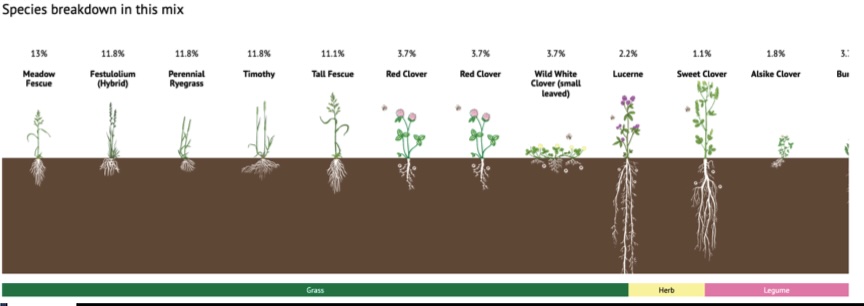 Cotswold Seeds — Herbal Heavy Land Ley for Medium and Clay Soil, the grass-inclusive mix we're using as the reference blend throughout this section.